This entry is basically how I feel about my progress throughout the project.
Evaluation Success... After looking at where the group stands currently, I would say that we did pretty well in making an interview, not so much in making a well polished interview. The time and effort spent on the project was almost the bare minimum, as the me and the rest of the group did everything in the last minute. Our finished product would be (Because it isn't even done yet by the time i'm writing this) barely half of what we imagined it to be at the start of the year. The team needed someone to essentially lead the group and ensure work was done, and the absence of such a figure lead to this. My group faced a lot of problems due to a variety of sources, and we had been able to make do by cutting corners. The problems with cutaways were replaced by editing in dissolves. Audio problems were simply left in and subtitles will hopefully help people understand the interview better. The framing problems could be refined using editing. Overall, we were creative in making do with what we had. The product itself is not really creative because it takes heavy inspiration from some interviews. It can be considered original if you take into account the lack of cutaways and different angles and effects.
My previous entry explained what happened during the shooting of the documentary, this is what the group did afterwards.
·Discuss the type of editing software you have
chosen and why.
·Discuss the creative thinking process behind
your editing choices (technical and aesthetic).
·How does your segment reflect your ability to
communicate effectively in film language? Use screenshots where appropriate.
Post-Production Pre-Editing After watching the rushes and analysing the mistakes (as explained in the previous entry), I, as editor, decided to use After Effects CS 5 for it's wide range of effects that I could use to refine the documentary. However, after realising the file size was so big (111 GB) that after effects's ram re play couldn't load them fast enough, I moved to using Adobe Premiere Pro CS 5. Here I could cut and edit easily and playback to preview my work fast enough. Editing First thing I did was to cut down as much dead footage (footage where nothing happens, usually when Pak Andy took breaks or takes a while to recall something) as possible. This was by far the easiest part, as I just re-watched the footage, took notes on where to cut along the way and cut them when I was done. Then I inserted a blank black image and inserted it into the footage to designate where the Cut Aways would be inserted at. After consulting with Ibu Lis (Last week), she told us that chances are, we won't be able to film cutaways on time so that I had to use dissolves to transition between the jump cuts. To do this, all I had to do was apply an effect to each one of the individual would be cutaway segments. She also reminded us how the editing process needed to be split, so I was going to do a bulk of the visual editing, Luthfi was going to help with the sound and end sequence, Min Kee will do the title sequence. During the editing itself, since I had only 1 camera angle to work with and no cutaways, as explained before, my job was just to cut the clips, organise, delete anything non important, and add dissolves in place of cutaways. Also, I had to add subtitles, just so the viewers can read what is being said incase they couldn't hear it through audio.
My previous entry explained what happened before the shooting of the documentary, this is what happens during the day of the shoot.
Production Setting up The group was blessed to have Pak Andy as our interviewee. Before the shoot, he explained to us that we could skip last period to set up the scene. So me and Min Kee were able to skip last period to set up while Shona and Luthfi weren't allowed to by their teachers. We did everything as planned, we did two point lighting, and I sat in the chair where Pak Andy would sit at to test everything out. The group used the school's sony camera which yields high definition recordings and two LED lights, we reduced the strength of one of the LED lights to about 50% so that it could become our fill light. One thing that we didn't do was check for audio, which we didn't need to at the moment because nothing was interfering with the audio. But what we didn't take into account is the inevitable swarm of kids who were going to be filling the hallways when the bells rang and school was up.
Interview So when the bells rang, we agreed that it was time for us to start shooting. However, we had some trouble setting up the lights as they weren't the ones we helped set up during the workshops and Shona and Luthfi just came and they helped us redo some set ups that we did wrong. So ten to thirty minutes after that the interview started. Being the interviewer, I asked Pak Andy questions and had to think on my feet to ask follow up questions. Andy's responses were very entertaining and satisfying. The interview took over twenty minutes, and we wrapped it up with Pak Andy praising the school and asking us to pay for his acting services (Which was a joke). It all went pretty smoothly. Problems One major flaw of ours was that, we were all procrastinators. By the time we looked at the footage, it was too late. We realised a couple of things that went wrong. Firstly, for half of the interview, there was heavy background noise and for the other half relative silence. Which caused a problem of course. I recently found out there was no way to edit that out and Luthfi couldn't do anything after taking a crack at it either. We needed to do reshoots but by then, It was too late, and the group doubted Pak Andy was going to accept to reshoot three weeks after the original shoot. However, at least we could still understand what I and Pak Andy were saying throughout the footage. Second, the interview was too long. We all originally planned for a ten minute interview, we didn't think it was going to exceed that until the actual day of the shoot. I don't know why we didn't think about it sooner, maybe it was Pak Andy's excellent story telling skills, but now we had too many clips in our hand. It was easy to solve this, just pick a focus and cut everything else out, but the group had a hard time deciding what to focus on. Third, we only just realised that It would've been better to show Pak Andy's whole upper body to utilise his hand movements for the film. It would've maybe helped with the visuals and the feel for the story overall. Fourth, some of the shots showed the shadows of the crew over some parts of Pak Andy. It just looks bad and creates inconsistencies. This also calls for a reshoot that won't happen.
In the start of the year, as explained in my previous blog entry, the class was split into groups. Each group was to make their own documentary in the form of an interview. Most groups decided to interview some of the teachers in Globaljaya, some tried to do something unique and mimic buzzfeed by interviewing a bunch of random students with a specific topic in mind. My group, consisting of me (Fajar), Shona, Luthfi, and Min Kee, decided to interview Pak Andy, the middle school principal. I was to be the editor and interviewer, Shona the director, Luthfi the lighting and audio editor, and Min Kee the cameraman. This entry will go over what we did before producing the interview. Pre-Production Interview Presentation After shooting our interview (Yes after, but this segment was to be included in this entry anyways) Ibu Lis told each group to choose an interview, analyse it for techniques, and explain how we would apply it to our interview. Even though it was too late, this was done just to test and further improve our knowledge of documentary making. For our presentation, my group chose an interview by David Letterman with Shia Lebouf (shown below). In this video, we basically explained how there were different camera angles to show emphasis on different things according to who's talking and whatnot. The group also explained in the presentation, that the interview uses medium closeups (closeups but for the upper half of the torso and not just the face) for this and that two shots (Medium closeups on two people) were also used when both the interviewer and the interviewee were talking simultaneously or one after the other. The interview did use cutaway shots by manipulating the camera angles and focus, to make the jump cuts seamless. However, during the presentation we did not talk about how we would apply these techniques, essentially forgetting the main reason for the interview.
Shia LaBeouf - Funny Birthday-Police-Story
The group wanted to incorporate the camera angles and mid shot's during the shoot, to make pak Andy the focus of the interview. However, we aren't going to shoot the interviewer and won't be switching angles that much due to the amount of equipment available. Workshops Way back in term 1, the class actually had lighting and camera workshops so we can get some more hands on experience. It was just to help us get more familiar with the cameras and the lighting setups. Also to get us more familiar with the different shot types, possible interview layouts, and possible lighting layouts. My group did not get a chance to use the equipment in the lighting workshop. So the only way we got anything off of that was by helping other groups set up and observing them. We learned how to set up the equipments in both the workshops and how to take various shots during the camera workshop. During the lighting workshop, we got to learn how to setup and possible lighting plans to use during the interview. Which was useful but we didn't get to experiment with out own plans. Planning By this point, the group has already chosen the venue of the interview, which was at the waiting room outside of Pak Andy's office, and had gotten out finished script approved by him. The script was simple and we estimated it would take about 10 minutes for Pak Andy to answer them all. Now all we had to do was to decide what we were going to do during the day of the interview. We decided to use two point lighting when shooting and also to figure out what to do when it was actually shooting time.
Welcome to my blog! In this blog, I will document my progress during my Media Studies class. In it will contain information regarding what I did in class, things I learnt in class, and my opinion towards the topic in general.
What happened so far? As of today, I have already endured about 9 sessions in Media Studies. So what has the class done so far? First Week Nothing interesting happened in the first week. The class was split into groups and signed up for the class in Edmodo while also being briefed about the different criteria's that we were being assessed on and what the class was about. We also completed a short questionnaire regarding out knowledge about documentaries. Second Week In the following week, we started going more in depth in to the world of documentaries. Most notably we learned about BYOD which stands for Bring Your Own Documentary and also about the different types of documentaries and some examples taken from the top grossing documentaries of all time. Third Week Finally, last week the class started researching individually about the different aspects of a documentary and two documentaries, "Nanook of the North" and "Chronique d'Un Eté". We also watched a mini documentary together in class named "Cuba 15" followed by a discussion period.
Things I've learned Here are some of the things I learned in Media Studies class. What is a documentary? A documentary can be described as either a film or a TV program that is made with the intention of providing facts. Documentaries must be truthful, realistic, not superficial, informational, educational, and have show different point of views. They often, not always, also include a narrator. Documentaries differ from movies because movies are often fictional or contain over dramatized facts and are usually made to entertain, while documentaries are made to educate and should show hard cold facts. Compare a movie like Interstellar (2014) to a documentary like Space (2001) for example. "Interstellar", although for the majority it stays true to modern astrophysics, tells a fictional story set in outer space in the far future while "Space" is a nonfictional series that covers almost everything someone should know about outer space using facts. These are the five genres of documentaries followed by an example of each
Nature: Earth (2007)
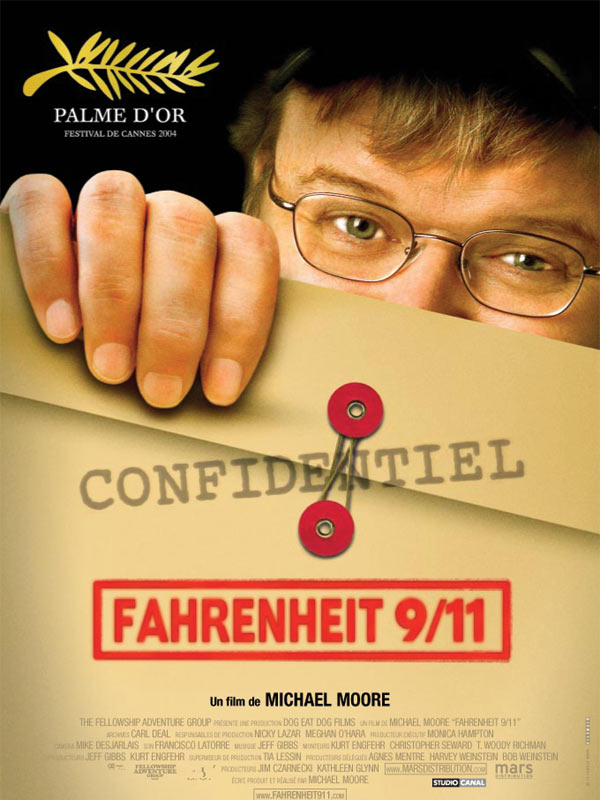
Poster for "Fahrenheit 9/11"
Historical: 2016 Obama's America (2012)
Cultural: Fahrenheit 9/11 (2004) directed by Michael Moore
Travel: Baraka (1993) directed by Ron Fricke
Biography/Auto Biography: Katy Perry Part Of Me (2012)
Top grossing documentaries In class, we were shown a short little video which showed the top ten grossing documentaries as of 2014.
Fahrenheit 9/11 (2004) $119 Million
March of the Penguins (2005) $77.4 Million
Justin Bieber Never Say Never (2011) $73 Million
2016 Obama's America (2012) $33 Million
Earth (2009) $32 Million
Chimpanzee (2012) $29 Million
One Direction: This is Us (2013) $28.9 Million
Katy Perry Part of Me (2012) $25.2 Million
Sicko (2007) $24.5 Million
An Inconvenient Truth (2006) $23.8 Million
I can't for sure say why all of the documentaries are up there, but i can explain why some of them are. The biographies and auto biographies on this list grossed well due to the subject's peak in popularity during the showing of the documentaries. The Disney movies are obviously up there due to the publishers popularity. As for 2016 Obama's America, it was probably popular at the time due to the ongoing elections at 2012. Fahrenheit 9/11 capitalizes on the tragedy that happened two years before it which is why it is up there. This goes to show that timing could be the difference between a high grossing documentary and a low grossing documentary.
Poster for "An Inconvenient Truth"
One thing to note is that the revenues generated by each of the documentary's do not determine how good the documentary is.
Nanook of the North (1922) Nanook of the North was one of the first documentaries we were asked to research. It is also coincidentally one of the first documentaries ever made. This silent cultural documentary showed the daily life of Inuits in Canada's Quebec region and was directed by Robert J. Flaherty.
During class, we weren't given the chance to watch it, instead we were told to research what it was about and watch the trailer.
This documentary was highly praised and gained a bit of controversy back in it's day due to some of the scenes being scripted.
It was important to look up and study because we can learn how documentary making was back in the day and the fundamentals of a documentary from just one documentary.
The second documentary the class didn't watch but researched about was "Chronique d'Un Eté" or "Chronicle of a Summer". Directed by Edgar Morin and Jean Rouch, this cultural documentary explored the happiness of the French society's working class by showing random interviews that with random people in the street.
This documentary was also critically acclaimed and is considered a very experimental yet innovative film. Due to this, it was branded cinéma vérité or true cinema.
When comparing "Chronicle of a Summer" with "Nanook of the North", we can clearly see how far technology in the film industry has leaped between 1922 and 1961. For example, we can see that "Chronique d'Un Eté" had sound while "Nanook of the North" didn't.
Cuba 15 is the first cultural documentary the class watched together. This documentary focused on a Cuban girl turning 15 and establishes the daily life and culture of Cuban's people.
This documentary was directed by Elizabeth Schubz.
To me, this documentary showed how a documentary can be about anything and that passion can really turn an otherwise bland concept on paper to an entertaining documentary.
Cuba 15 received awards in some small film festivals such as the Kudzu Film Festival and the Berlin International Film Festival
BYOD or Bring Your Own Documentary is basically a show hosted by a woman named Ondi Timoner that discusses what is currently happening in the world of documentaries. BYOD helps a lot with advertising certain events or documentaries and spreads the passion of film making.
Opinions
Below are my opinions on the things I have studied and the documentaries I have watched.
Documentaries
My favorite documentary would have to be "The Act of Killing" which was released in 2012 and was directed by Joshua Oppenheimer.
This documentary focuses on a mass murdering Indonesian squad leader Anwar Congo and how he reenacts some of his mass killings during the 60's when asked to do so on camera.
I personally like this historical documentary because it shines some light on how things were back in the 1960's and taught me some things that will never be taught in class. The thing that I liked the most was how more and more mentally deranged Anwar became the more he tried to remember and reenact some of his murders.
This documentary taught me a lot about human nature and the history of Indonesia, and because of that my favorite documentary genre has to be history.
Trailer for "The Act of Killing"
(Full version can be found on YouTube)
Nanook of the North
My first impression of the trailer and overall concept of the movie was that it would be a very educational documentary to watch and I wouldn't mind seeing it, however knowing the limitations regarding sound and color at that time, i don't know if i could bring myself to watch this documentary without getting bored. Chronique d'Un Eté From the trailers and excerpts i watched, I can tell that this documentary is one that I would watch. Why? Well personally I am interested in psychology and also the way old governments work outside of Indonesia. Cuba 15 I expected Cuba 15 to be quite boring and uninteresting. After watching however, I liked it. The way they displayed the information and edited the scenes really made it entertaining and worthwhile to watch. BYOD
After having watched about half of an episode, I could say that Bring Your Own Doc is a great show for anyone trying to learn more about documentaries and films. Each episode of the show has Ondi talk about a certain documentary with it's creator, like what the creator was going for, the inspiration, the struggles, etc.
I would definitely watch this if I stumble across one that's about a documentary that I've watched or a documentary that I might watch.
Goals
Concerning all things related to Media Studies, I have set up a few goals for me to achieve by the end of this year.
Make a good documentary
Master at least one of the roles in film making
Watch more documentaries
Get up to date in the world of documentaries
Final Notes
My future blog entries will use the same fundamental structure of this one while also improving it.