In this blog, I will document my progress during my Media Studies class. In it will contain information regarding what I did in class, things I learnt in class, and my opinion towards the topic in general.
What happened so far?
As of today, I have already endured about 9 sessions in Media Studies. So what has the class done so far?
First Week
Nothing interesting happened in the first week. The class was split into groups and signed up for the class in Edmodo while also being briefed about the different criteria's that we were being assessed on and what the class was about. We also completed a short questionnaire regarding out knowledge about documentaries.
Second Week
In the following week, we started going more in depth in to the world of documentaries. Most notably we learned about BYOD which stands for Bring Your Own Documentary and also about the different types of documentaries and some examples taken from the top grossing documentaries of all time.
Third Week
Finally, last week the class started researching individually about the different aspects of a documentary and two documentaries, "Nanook of the North" and "Chronique d'Un Eté". We also watched a mini documentary together in class named "Cuba 15" followed by a discussion period.
Things I've learned
Here are some of the things I learned in Media Studies class.
What is a documentary?
A documentary can be described as either a film or a TV program that is made with the intention of providing facts. Documentaries must be truthful, realistic, not superficial, informational, educational, and have show different point of views. They often, not always, also include a narrator.
Documentaries differ from movies because movies are often fictional or contain over dramatized facts and are usually made to entertain, while documentaries are made to educate and should show hard cold facts.
Compare a movie like Interstellar (2014) to a documentary like Space (2001) for example. "Interstellar", although for the majority it stays true to modern astrophysics, tells a fictional story set in outer space in the far future while "Space" is a nonfictional series that covers almost everything someone should know about outer space using facts.
These are the five genres of documentaries followed by an example of each
- Nature: Earth (2007)
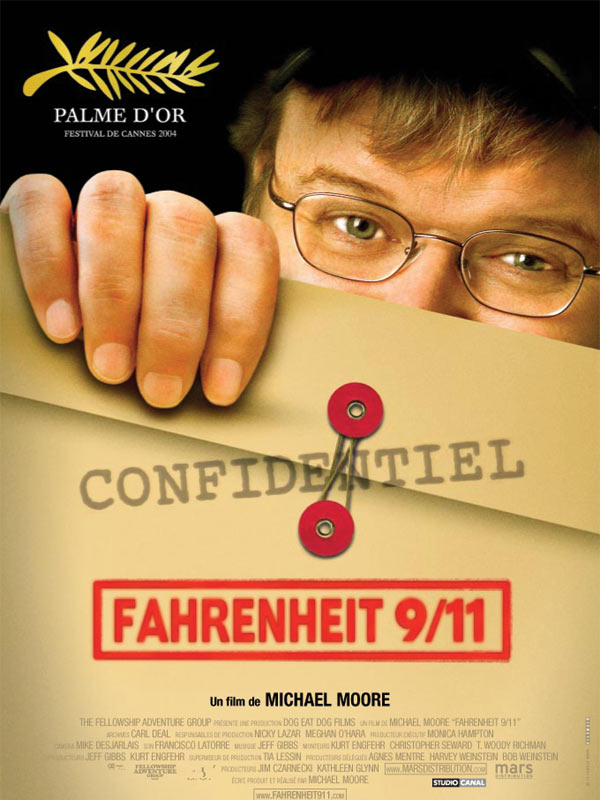
Poster for "Fahrenheit 9/11" - Historical: 2016 Obama's America (2012)
- Cultural: Fahrenheit 9/11 (2004) directed by Michael Moore
- Travel: Baraka (1993) directed by Ron Fricke
- Biography/Auto Biography: Katy Perry Part Of Me (2012)
In class, we were shown a short little video which showed the top ten grossing documentaries as of 2014.
- Fahrenheit 9/11 (2004) $119 Million
- March of the Penguins (2005) $77.4 Million
- Justin Bieber Never Say Never (2011) $73 Million
- 2016 Obama's America (2012) $33 Million
- Earth (2009) $32 Million
- Chimpanzee (2012) $29 Million
- One Direction: This is Us (2013) $28.9 Million
- Katy Perry Part of Me (2012) $25.2 Million
- Sicko (2007) $24.5 Million
- An Inconvenient Truth (2006) $23.8 Million
I can't for sure say why all of the documentaries are up there, but i can explain why some of them are. The biographies and auto biographies on this list grossed well due to the subject's peak in popularity during the showing of the documentaries. The Disney movies are obviously up there due to the publishers popularity. As for 2016 Obama's America, it was probably popular at the time due to the ongoing elections at 2012. Fahrenheit 9/11 capitalizes on the tragedy that happened two years before it which is why it is up there.
This goes to show that timing could be the difference between a high grossing documentary and a low grossing documentary.
This goes to show that timing could be the difference between a high grossing documentary and a low grossing documentary.
 |
| Poster for "An Inconvenient Truth" |
One thing to note is that the revenues generated by each of the documentary's do not determine how good the documentary is.
Nanook of the North (1922)Nanook of the North was one of the first documentaries we were asked to research. It is also coincidentally one of the first documentaries ever made. This silent cultural documentary showed the daily life of Inuits in Canada's Quebec region and was directed by Robert J. Flaherty.
During class, we weren't given the chance to watch it, instead we were told to research what it was about and watch the trailer.
This documentary was highly praised and gained a bit of controversy back in it's day due to some of the scenes being scripted.
It was important to look up and study because we can learn how documentary making was back in the day and the fundamentals of a documentary from just one documentary.
A short excerpt from "Nanook of the North"
(Full version can be found on YouTube)
Chronique d'Un Eté (1961)
The second documentary the class didn't watch but researched about was "Chronique d'Un Eté" or "Chronicle of a Summer". Directed by Edgar Morin and Jean Rouch, this cultural documentary explored the happiness of the French society's working class by showing random interviews that with random people in the street.
This documentary was also critically acclaimed and is considered a very experimental yet innovative film. Due to this, it was branded cinéma vérité or true cinema.
When comparing "Chronicle of a Summer" with "Nanook of the North", we can clearly see how far technology in the film industry has leaped between 1922 and 1961. For example, we can see that "Chronique d'Un Eté" had sound while "Nanook of the North" didn't.
A short excerpt from "Chronique d'Un Eté"
(Full version can be found on YouTube)
Cuba 15 is the first cultural documentary the class watched together. This documentary focused on a Cuban girl turning 15 and establishes the daily life and culture of Cuban's people.
This documentary was directed by Elizabeth Schubz.
To me, this documentary showed how a documentary can be about anything and that passion can really turn an otherwise bland concept on paper to an entertaining documentary.
Cuba 15 received awards in some small film festivals such as the Kudzu Film Festival and the Berlin International Film Festival
BYOD or Bring Your Own Documentary is basically a show hosted by a woman named Ondi Timoner that discusses what is currently happening in the world of documentaries. BYOD helps a lot with advertising certain events or documentaries and spreads the passion of film making.
Opinions
Below are my opinions on the things I have studied and the documentaries I have watched.
Documentaries
My favorite documentary would have to be "The Act of Killing" which was released in 2012 and was directed by Joshua Oppenheimer.
This documentary focuses on a mass murdering Indonesian squad leader Anwar Congo and how he reenacts some of his mass killings during the 60's when asked to do so on camera.
I personally like this historical documentary because it shines some light on how things were back in the 1960's and taught me some things that will never be taught in class. The thing that I liked the most was how more and more mentally deranged Anwar became the more he tried to remember and reenact some of his murders.
This documentary taught me a lot about human nature and the history of Indonesia, and because of that my favorite documentary genre has to be history.
Trailer for "The Act of Killing"
(Full version can be found on YouTube)
Nanook of the North
Chronique d'Un Eté
From the trailers and excerpts i watched, I can tell that this documentary is one that I would watch. Why? Well personally I am interested in psychology and also the way old governments work outside of Indonesia.
Cuba 15
I expected Cuba 15 to be quite boring and uninteresting. After watching however, I liked it. The way they displayed the information and edited the scenes really made it entertaining and worthwhile to watch.
BYOD
After having watched about half of an episode, I could say that Bring Your Own Doc is a great show for anyone trying to learn more about documentaries and films. Each episode of the show has Ondi talk about a certain documentary with it's creator, like what the creator was going for, the inspiration, the struggles, etc.
I would definitely watch this if I stumble across one that's about a documentary that I've watched or a documentary that I might watch.
Goals
Concerning all things related to Media Studies, I have set up a few goals for me to achieve by the end of this year.
- Make a good documentary
- Master at least one of the roles in film making
- Watch more documentaries
- Get up to date in the world of documentaries
Final Notes
My future blog entries will use the same fundamental structure of this one while also improving it.
